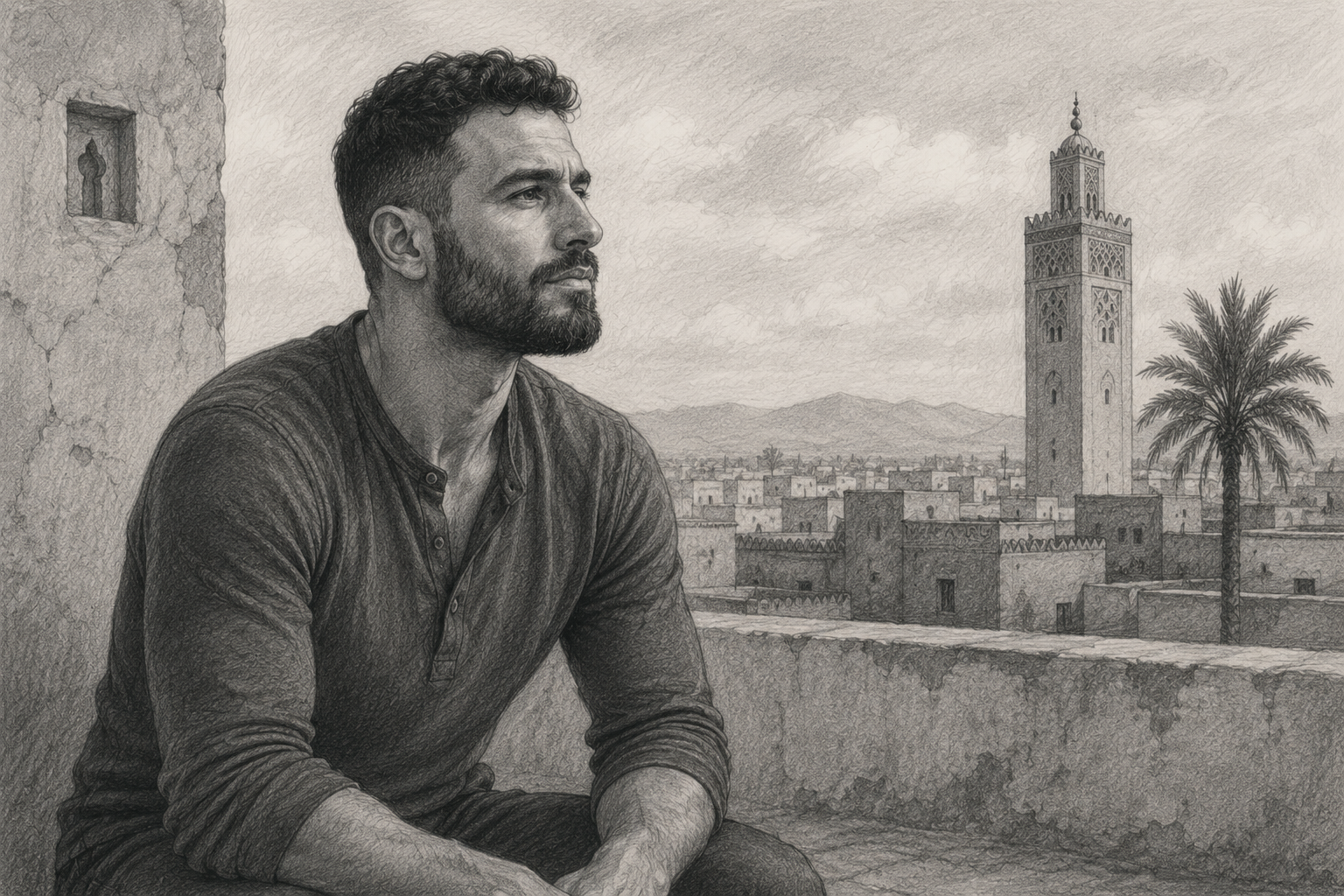
Clinical Reflections on a Case of Complex Male Sexual Trauma in the Moroccan Context
Introduction
Male sexual trauma remains one of the most silent and underexplored territories in contemporary psychotherapeutic practice, particularly within societies where representations of masculinity, honour, and virility make such experiences almost impossible to think, symbolise, or openly disclose.
In many cultural contexts, male victims of sexual abuse rarely seek therapy by directly naming what they have experienced. Trauma often arrives disguised behind apparently unrelated symptoms: depression, addictions, violence, relational disturbances, impulsivity, hypersexuality, psychosomatic symptoms, or antisocial behaviours.
The present clinical case illustrates this reality with remarkable intensity. It also allows reflection on several dimensions that are rarely explored together:
- the traumatic sexualisation of psychological development;
- processes of identification with the aggressor;
- the construction of defensive hypermasculinity;
- dissociative mechanisms;
- and the possibilities of psychic transformation when a sufficiently safe therapeutic space finally allows trauma to become thinkable.
The importance of this case also lies in what it reveals about certain specificities of male sexual trauma within the Moroccan cultural context, where silence, shame, and fear of exposure frequently push patients to hide behind superficial diagnoses that remain disconnected from the true traumatic core.
Clinical Presentation of the Case
«MM» is a forty-year-old married man, father of a two-year-old son, working as a small taxi driver. He is the second youngest in a family of ten children composed of eight sisters and one brother.
From the very first encounter, one element immediately attracted clinical attention: «MM» had crossed several major cities and travelled hundreds of kilometres to consult in Berrechid despite the existence of much closer therapeutic options.
Initially, the patient presented himself under the diagnosis of “depression,” a diagnosis repeatedly given to him by various psychiatrists he had previously consulted.
However, deeper exploration quickly revealed a far more complex psychological organisation.
«MM» reported recurrent nightmares since the age of five, a chronically tense family atmosphere, pervasive childhood fear, profound inner insecurity and a constant sense of vulnerability.
At the age of six, he experienced a first sexual abuse by a fifteen-year-old adolescent from the neighbourhood who lured him onto a rooftop under the pretext of showing him pigeons.
Three years later, a second abuse occurred in a forest. Alongside these events, several indicators suggested an early and deeply confused sexualisation of psychological development. Voyeuristic behaviours involving his sisters, compulsive masturbation, intense sexual excitement associated with shame and progressive blurring of psychological and bodily boundaries.
One particular scene occupied a central place in the patient’s traumatic experience. At the age of eleven, while secretly observing his older sister taking a bath, «MM» began masturbating behind the bathroom door and was suddenly surprised when she unexpectedly opened it.
During the later therapeutic work, «MM» would not describe this episode merely as an embarrassing memory, but rather as “the greatest trauma of my entire life.”
During adolescence, several major defensive organizations progressively emerged. Following another attempted abuse by a brother-in-law, «MM» gradually constructed a hypermasculine identity through bodybuilding, aggressiveness, violent reputation, physical intimidation and the consumption and dealing of psychotropic substances.
Yet this defensive masculinity was accompanied by a progressive identification with the dominant position. At the ages of sixteen and eighteen, «MM» himself committed abusive acts toward younger boys, at times reproducing the exact same strategy used by his first abuser: attracting the victim by promising to show pigeons on a rooftop.
Sexual Trauma and the Organisation of Development
This clinical trajectory invites us to move beyond a simplistic understanding of sexual trauma as an isolated event. In MM’s case, traumatic experiences progressively participated in shaping psychological development itself.
Trauma no longer appears merely as a wound, but as a developmental organizer. The relational, bodily, and sexual world became structured very early around intrusion, confusion, shame, traumatic excitation and fear.
Voyeurism occupies a particularly important psychological function here. Beyond sexual excitation, it also seems to represent an attempt to regain a sense of mastery over a sexual universe initially experienced from a position of passivity and vulnerability.
Looking allows one to see without being seen, to penetrate without being penetrated, and to maintain distance from a psychic territory experienced as profoundly threatening.
Defensive Hypermasculinity and Fear of the Other
One of the most central aspects of this case lies in the progressive construction of defensive hypermasculinity. Following repeated experiences of abuse and vulnerability, «MM» gradually developed hardness, aggressiveness, domination, antisocial behaviours and an intimidating image.
Yet this hypermasculinity appeared less related to genuine narcissistic security than to a desperate attempt to annihilate an internal position experienced as vulnerable, feminized, and endangered.
Throughout the therapeutic process, one element progressively emerged as fundamental: a profound fear of other human beings.
Aggressiveness, impulsivity, and violence seemed to function as defences against a permanent state of hypervigilance and relational insecurity. The full meaning of this clinical hypothesis became particularly evident when «MM» later described one of the most important therapeutic changes as: “The total disappearance of fear toward others.”
An Indirect Clinical Approach to Trauma
The Moroccan cultural context often imposes an indirect clinical approach to male sexual trauma. Patients rarely arrive explicitly naming the abuse.
Trauma instead presents itself through depression, addictions, violence or relational dysfunctions. In such contexts, clinical exploration requires careful attention to detours, inconsistencies, symptomatic disguises, and implicit formulations.
During the anamnesis, «MM» interrupted the therapist and asked: “Why did none of the psychiatrists I previously consulted ever ask me these kinds of questions?”. Later, he added: “The more you ask me these questions, the more comfortable I feel.”
This reaction illustrates something essential. The psychological relief that may emerge when a person finally experiences being understood beyond the limits of superficial diagnosis.
Traumatic Work and the Early Experience of Transformation
One of the central objectives of the therapeutic work was to allow the patient, very early in the process, to experience concretely that change was possible.
Although classical trauma approaches often recommend beginning with less emotionally charged material, the work rapidly focused on the traumatic scene identified by «MM» himself as the central trauma of his life.
Using PTR (Reassociative Trauma Psychotherapy), the traumatic processing rapidly produced visible changes in the patient’s internal state. At the end of the session, «MM» appeared deeply astonished by the speed of the transformation he experienced.
According to clinical observation, his facial expression reflected a form of positive bewilderment, as if the psyche were suddenly discovering that what had remained frozen for decades could finally begin to move.
From Acting Out to Symbolisation: The Therapeutic Function of Writing
Between sessions, «MM» was invited to write letters addressed to his victims. These letters were never intended to be sent. Their function was primarily symbolic and psychological.
This writing process appeared to fulfil several major therapeutic functions. Notably restoring the capacity to perceive the other as a subject, transforming action into thought, opening a path toward elaboration of guilt, and reintroducing psychological continuity into a previously fragmented personal history.
During the following session, «MM» displayed significant discomfort at the idea of reading the letters aloud. However, the progressive reading process—combined with requests for clarification, elaboration, and emotional development—generated considerable psychological effects. «MM» then described a profound sense of regret, an intense feeling of liberation, the sensation of being relieved from an enormous psychological burden, and a substantial reduction in medication consumption during the period of writing.
This phase appeared to mark a fundamental shift from a psychic organization dominated by acting out, dissociation, and splitting toward the beginnings of symbolic elaboration.
Observed Transformations
At subsequent sessions, several major transformations had emerged. For example, significant reduction in aggressiveness, improved relational self-control, renewed capacity to interact socially, gradual recovery of self-confidence, disappearance of traumatic intrusions and reminiscences, feelings of inner peace, improvement in marital intimacy, and the discovery of previously neglected personal competencies, particularly in driving.
At the same time, previously dissociated material also began to emerge like old family conflicts, memories that had been entirely amnesic, and the resurfacing of painful affects. These emergences did not appear to reflect deterioration, but rather a progressive return of psychological circulation after the reduction of chronic survival mechanisms.
Theoretical Reflections
This case raises several important questions.
First, it reminds us that certain presentations of “chronic depression” may actually conceal far more complex traumatic organizations.
Second, it highlights how certain forms of hypermasculinity may function as defences against early experiences of vulnerability, intrusion, and psychological insecurity.
Third, it illustrates how male sexual trauma may remain hidden for years beneath layers of shame, violence, addictions, and antisocial behaviours.
Finally, this case demonstrates that sufficiently safe therapeutic work may relatively quickly facilitate restoration of relational capacities, reduction of hypervigilance, and the beginning of a more integrated reorganization of identity.
Conclusion
MM’s case reveals the profound complexity of male sexual trauma within cultural contexts where traumatic speech remains deeply inhibited.
Behind the image of the “tough man,” the violent individual, the impulsive subject, or the drug dealer, there existed in reality a psychological organization fundamentally structured around fear, shame, and survival.
The therapeutic work did not merely consist of processing traumatic memories. It also allowed a progressive transition from acting out toward symbolization, restoration of psychological continuity, and the emergence of the possibility of existing outside a rigid traumatic identity.
Perhaps one of the most important lessons of this clinical situation is the following: Sometimes, behind certain forms of violent hypermasculinity, what hides is not power, but a desperate attempt never again to return to the original position of vulnerability.
How to cite this article
You may use the following reference to cite this article:
Last updated: 14 June 2026